

Hopefully you’ve figured out the basics of your 401(k). Maybe you’ve even figured out whether or not you should contribute to your 401(k) pre-tax or Roth. But what about this after-tax contribution? Otherwise known as the “mega backdoor Roth.”
Around 2018 (when this blog post was originally published, many major revisions ago), after-tax contributions were a precious rarity. By now, most major tech companies offer them. You can see whether your 401(k) plan offers them on the contributions page of your 401(k) portal. Right where it allows you to set contribution percentages for pre-tax and Roth…it might also have an “after-tax” section.
After-tax contributions to your 401(k) can help you supercharge your retirement savings, in an amazingly tax-savvy way.
How After-Tax 401(k) Contributions Work
Step 1. Put Money into Your 401(k).
You can get money into your 401(k) in three ways:
- The “normal” contribution from your paycheck
Put into either your pre-tax account or your Roth account (or both!). The “basic limit” for these contributions is $24,500.
If you’re 50 years old or older, you can contribute another $8000, for a total of $32,500. [updated for 2026] - Company contributions (usually in the form of a “match”)
If you’re lucky, your company will also match some of your contributions. Some matches are generous, some are not. Nothing you can do about it. - After-tax contributions
Even though both these and Roth 401(k) contributions are made with after-tax money (i.e., you don’t get any tax benefit this year by making the contribution), they are not the same thing. They are treated differently.
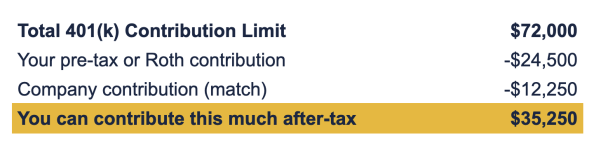
Added together, these three numbers cannot exceed $72k in 2026 (higher if you’re 50 or older; even higher-er if you’re 60-63 years old).
For example, if your company provides a 50% match of your contribution, you can contribute up to $35,250 after-tax:
So, now you could have many “buckets” of money in your 401(k):
- Pre-tax contributions + earnings
- Roth contributions + earnings
- After-tax contributions + earnings
- Company match contributions + earnings
Step 2. Move Your After-Tax Contributions into a Roth account.
This move-to-Roth is where the real benefits begin.
Most of the big tech companies allow you to do this in an amazingly awesome way that I’m frankly surprised the IRS hasn’t gotten shirty about: You can set it up so that as soon as that after-tax money is contributed, it is instantly/automatically converted to your Roth 401(k) sub-account.
Why is this awesome? Because this means that not only the contributions but also all subsequent earnings on the contributions will be tax-free, because they’re all in the Roth account.
In practice, you should:
- Set up after-tax contributions on the 401(k) website. Usually you can do this right where you’re designating the % to go to pre-tax and the % to go to Roth. There will be another section for “after-tax.”
- Find the widget/checkbox/what-have-you that allows you to automatically convert after-tax contributions to Roth.
- If there is no obvious way to do this on the website, then you need to call your 401(k) provider on the phone and say, “Hey there. I have started making after-tax contributions to my 401(k). I would like those after-tax contributions to be automatically converted to my Roth sub-account. Could you please set that up for me?”
That should be it. All future after-tax contributions should be shoved into the Roth sub-account without further effort on your part. Of course, I’d check after a paycheck or two to make sure.
If your company’s 401(k) doesn’t allow this intra-401(k), automatic conversion, your other options are:
- Roll your 401(k) into an IRA when you leave the company or when your company terminates or replaces your 401(k) plan. This way you can at least get all future earnings on the after-tax contributions into a Roth account, even if they have been pre-tax up until now.
- If your 401(k) allows “in-service withdrawals,” you can (probably manually) roll those after-tax contributions into a Roth IRA every paycheck or two.
If You Roll Your 401(k) into an IRA, Pay Attention to How Each of These Buckets of Money Gets Treated
Pre-tax contributions and earnings, and your Company match and earnings, will go into a pre-tax IRA.
Roth contributions and earnings and the after-tax contributions will go into a Roth IRA.
Where the earnings on your after-tax contributions go depends on whether you had the after-tax contributions converted to Roth inside of your 401(k). If you did, then the earnings are Roth money. If not, then the earnings are pre-tax money.
You want to make sure the money ends up in the right kind of IRA. Sometimes “paperwork” gets screwed up and Roth/after-tax money ends up in a pre-tax IRA, or vice-versa, and both are bad. If you catch this mistake, call the company where your IRA lives and they can help you fix it.

The upshot: You can put an extra $35,250 into a Roth account every year. For those of you earning more than $252k (married) or $168k (single) in 2025, you are not eligible to contribute to a Roth IRA at all. And even if you were eligible, the contribution limit is $7500/year. So, this is an amazing opportunity.
Benefits of After-Tax 401(k) Contributions
Why would you make such contributions?
- You can get more much more money into tax-protected accounts than you’d be able to with the usual IRA contributions (witness the $7500 IRA limit vs. $72k 401(k) limit). The longer you have until retirement, the longer that money has to grow and benefit from its tax-protected status.
- You can get more money into a Roth IRA, specifically (eventually, when you roll it over) than your income might otherwise allow you to. If you and your spouse make, say $300,000/year, you simply can’t contribute to a Roth IRA. But you can put after-tax money into a 401(k), and then eventually roll those after-tax contributions (and hopefully earnings) to a Roth IRA.
- Your money is much more protected now than it would be if it were invested in a taxable investment account. Money in your 401(k) is protected from creditors, lawsuits, etc.
You Should Probably Make After-Tax 401(k) Contributions If…
- You have extra money to save for retirement.
If you’ve got daycare bills out the wazoo and you’re saving for a down payment, it’s possible you don’t have more retirement savings in you. For now. That’s ok. It’s also possible that you can put some money into the after-tax 401(k), just not max it out. - You’ve maxed out all other (appropriate) tax-protected ways of saving for retirement.
“Normal” 401(k) contributions are an obvious way to do this. If you’re still eligible for direct IRA contributions (in particular, if you’re eligible to contribute directly to a Roth IRA), do that first. Additionally, Health Savings Accounts can be an incredibly tax-savvy to save for retirement, possibly even better than your 401(k) or IRA! - You already have enough taxable savings and investments.
All of this money we’re talking about will be in some sort of retirement account. And retirement accounts make it difficult for you to get at your money (for good reason). There are taxes and penalties if you withdraw money. But money you have in bank accounts and in taxable investment accounts, aka brokerage accounts, you can use anytime for anything, no restrictions. This is why I think investing outside your 401(k) is so important. - Your 401(k) is a reasonably good plan.
You don’t want to trap extra money in your 401(k) every year if it’s a crappy plan, unless you have the opportunity to get the money out of it and into an IRA quickly. Fortunately, I find that plans that offer all these extra whiz bang features like after-tax contributions also seem to be on the ball when it comes to providing a good 401(k). - Your income is so high that just maxing out your “regular” 401(k) isn’t nearly a high-enough savings rate.
$24,500 is a nice bit of change to save for retirement. But if you’re making $400k/year, that’s only a 6% savings rate. In general, you’re gonna need a much higher savings rate to get to a financially sound retirement. If you put in an additional $35,250 after-tax (from our example above), that brings your savings rate up to 15%. Much better! - You are keen on early-ifying your retirement/financial independence.
Maybe you have goals that are more important to you than retiring early. Like, say, buying a home, or taking time off with a child, or starting your own business. (And yes, you could justly accuse me of some transference there.) You’re going to be able to support those goals more easily with money invested in a taxable account than with money in a retirement wrapper. - You can either do in-plan conversions of after-tax money to a Roth account, or you expect to be able to roll the money over to an IRA within the next few years.
If you can’t do in-plan conversions, then the earnings will be pre-tax. The sooner they can get into a Roth account (Roth IRA in this case), and have both the contributions and the earnings grow and remain tax-free, the better.
If contributing to your 401(k) after-tax reduces your take-home pay so much that you can’t pay your bills anymore, it can still work! It just requires a little more organization and I wrote a blog post about this very challenge.
After-tax 401(k) contributions can be a great way of super-charging your retirement savings in a way that will lower your future tax bill significantly.
Do you make good money? Are you good at saving? Can you almost taste that Financial Independence?