

Did you just get laid off from your tech job? Do you fear you might? And above all, you’re wondering what you’re supposed to do about health insurance?
<insert requisite rant about how health insurance, and therefore healthcare, is unforgivably tied to employment in this country until you’re 65 or poor enough>
To be frank, the situation is often not great. But also it’s probably better than you’re imagining (i.e., catastrophizing). I hope reviewing the most influential factors in this decision will go a long way towards calming your nerves.
Important Considerations when Choosing Post-Layoff Health Insurance
What other insurance is available to you?
You probably have three or four choices available to you after a layoff:
- COBRA (continuing your existing insurance). COBRA lasts for 18 months. Under special circumstances, it can be extended to 36 months in CA and NY (pinko commies that they are).
- Your spouse’s employer plan
- ACA Marketplace (colloquially, Obamacare)
- Medicaid. Many states care only how much income you’re making right now when determining Medicaid eligibility. If your household just lost all its income, you might qualify, as weird as that might sound.
Insurance buddies tell me there are other, though much less likely, options like off-exchange health plans, including association plans, short term medical, Heath share ministries (which are not in fact health insurance). I simply have no experience with them for my clients.
What is the all-in cost of each option?
“Paying the least amount of money” is obviously one of the major goals of choosing a health insurance plan.
If you knew, in advance, exactly what kind of healthcare you were going to need in the future, you could figure out how much you’d pay overall, between premiums and co-pays and coinsurances and deductibles.
Alas, you can’t know that. Your healthcare needs can be very hard to predict. To render this a reasonable calculation, then, I usually look primarily at a plan’s premiums and out-of-pocket (OOP) max because these numbers are knowable in advance. With these (and a nod to HSA tax savings), I can see the best-case scenario (no healthcare!) and the worst-case scenario (you need a bunch of healthcare).
Be sure to take into consideration any employer direct subsidy for COBRA (as opposed to them giving you a lump sum of money with the notional label “for COBRA” on it, money which you are allowed to use for anything, including a different health insurance plan).
How close are you to fully satisfying the deductible or even your OOP max on my current plan?
A brief review of deductibles and OOP maxes:
- After you have paid enough in healthcare bills to reach your deductible, your health insurance plan starts paying more of your healthcare bill for the remainder of the coverage year (usually this is the calendar year).
- After you reach your OOP max, your health insurance starts paying all of your healthcare bills (outside of your premiums and prescriptions).
If you change health insurance plans mid-year, then any amount of deductible or OOP max you’ve met gets reset to $0 on the new plan. Boo. We don’t want that. You might end up paying two OOP maxes in the same year! And those OOP maxes are No Joke (especially for you ACA warriors 😬).
That means that, if you’ve already reached the deductible, and certainly the OOP max, of your workplace health insurance plan, that leans heavily in favor of choosing COBRA for the rest of the coverage year, despite its high premiums: Most or all of your healthcare needs between now and the end of the year would then be covered by insurance.
If you’re going to switch at all, switching health insurance plans at the beginning of the new coverage year (usually January 1) is usually a good move. This helps milk the most out of your deductible and OOP max each year.
To what extent would you have to change your healthcare providers?
I have a client who could have improved her finances by switching health insurance plans. At that time, she also happened to be in the midst of major breast-cancer treatment, was already pretty overwhelmed by life, and could not fathom having to find new providers. In that case, it was absolutely the right choice to make the financially sub-optimal choice (that is, to not change health insurance plans).
This is a real consideration at any time, but especially when you know you have major health things going on.
So, if you’re thinking of changing away from your current insurance, check with the specific plan whether your existing or desired healthcare providers are covered by that plan. The same insurance company can have different plans, and healthcare providers might accept one plan and not another. I’d also double check by then confirming with the healthcare providers themselves.
If they don’t, do you have the wherewithal to manage finding new providers? And even if they do, do you have the wherewithal to manage the administrative hassle of a change in insurance bureaucracies?
ACA plans aren’t great out of state: Many ACA plans provide in-network care only in-state (and cover only emergency care when outside the state). By contrast, large-employer health insurance plans generally have nationwide coverage. If you travel out of the state frequently or have kids attending school out of state and you want to cover them with your insurance, an ACA plan is likely not a great choice.
Does your spouse or partner have insurance you can get on?
Lucky you! It might not feel lucky, what with the whole layoff thing. But because health insurance is still mostly tied to employment, you’re lucky to have access to employer-provided health insurance despite having, you know, no employer.
It might seem like a no brainer to move directly onto your spouse/partner’s health insurance plan. The loss of your job would count as a Qualifying Life Event (QLE). This triggers a Special Enrollment Period (SEP), which would allow you to join your spouse’s plan outside of open enrollment.
But that “usually” brings up a good point: You have to familiarize yourself with the rules of your spouse’s plan! Information like:
- Are you allowed to have both your COBRA coverage and the spouse’s coverage?
- How much will adding you to the policy cost?
You have some choices (depending on what your spouse’s plan allows):
- Switch immediately after your layoff to your spouse’s plan (most likely allowed)
- Stay on your health insurance (via COBRA) until the new coverage year, and then switch to your spouse’s plan. Be sure to enroll in your spouse’s plan during open enrollment. (most likely allowed)
- Maintain COBRA for your own plan as long as your former employer is paying (or even if they’re not, but you really want to maintain your existing coverage for a while) and enroll in your spouse’s coverage. (less certain about this being allowed)
A note of caution about #3 above: “Coordination of benefits” between the two plans can create administrative hassles. I often see this warning phrased with general, benign language (“There can be coordination of benefits issues”). I personally interpret that as “This is going to be administrative hell because everything healthcare billing and healthcare insurance is.” I ran my interpretation by an insurance colleague, and he agreed with it, saying, “Usually both carriers deny the claim and it can take months to straighten out. Meanwhile you continue to get bills and threatening letters about not paying for the services.” Because my clients (and presumably you) already have more than you can handle of stressful administrative bullshit in this world, I’m not going to go any further with this “double coverage” consideration.
Is your former employer paying for COBRA?
If you elect COBRA, it will cost 102% of the full premium. Your employer probably covered most or even all of the premium while you were an employee. You might not have a good idea of how much your health insurance cost your employer. Spoiler: It’s a lot. And on COBRA, you will pay the full premium plus an extra 2% administrative cost.
Unless they offer to cover COBRA for some number of months. Which is great!
If you’re single, then I can’t think of a downside of your employer paying for COBRA premiums, no matter how long they will. By the end of the subsidy, you:
- move to an ACA plan (go with God, and remember you’ll be resetting your deductible and OOP max when you change plans)
- continue paying the COBRA premiums yourself
- possibly qualify for Medicaid at that point, or
- hopefully have another job and can switch to their coverage
If you are married, are eligible to be added to your spouse’s employer plan, and your employer is paying for COBRA through to the end of the calendar year (which we’ll assume is the same as the coverage year)…Great. Simple. You should be able to move from COBRA to your spouse’s employer plan on January 1. Just to be sure to sign up for their health insurance during that fall’s open enrollment!
If the COBRA subsidies last not quite to the end of the year but close, then consider sticking with COBRA the whole year and simply paying the last month or two of unsubsidized coverage yourself.
Sticking with COBRA through the entire year means you don’t change policies mid-year. As discussed above, changing policies mid-year sucks in large part because any progress you’d made towards your health insurance deductible and OOP max goes bye-bye.
Okay, those were the simpler scenarios.
Instead, let’s say that the COBRA subsidies stretch into the new year by a few months. You’re sort of tempted to get as much free insurance as possible, right?
When that employer COBRA subsidy stops, it does not count as a special enrollment period to move to your spouse’s employer plan. If your COBRA subsidy stops at the end of April, you cannot move at that point to your spouse’s employer plan.
It does count as an opportunity, however, to enroll in an ACA marketplace plan. So, with that April termination, you can either enroll in an ACA plan (and reset your deductible and OOP max…oof) or continue paying COBRA for the remaining eight months of the year. Both of which likely cost a lot.
So, if your employer subsidy stretches into the new year, ask yourself: are the benefits of sticking with your existing plan (via COBRA) worth the extra cost you’ll incur versus just switching to your spouse’s plan on January 1?
Do you have the money? You can just pay to have better health insurance.
For most people, paying for health insurance and healthcare is something they have to very carefully fit into their budget. There is no wiggle room, and often there are lots of sacrifices. But if you have enough money, you can just pay for whatever pathway is easiest for you.
Workplace health insurance coverage is, in my experience, almost always superior to ACA coverage. So, if you want to make sure to maintain good health insurance, COBRA is probably the way forward, price be damned!
Does paying for COBRA for the next 18 (or 36) months cost a lot of money? Yes. But does it make your healthcare easier to access? Most likely. And while it might be morally offensive that it comes to this in this country, I can’t think of many things worthier of your dollar than good, easy-to-access healthcare.
Case Study
I have a client who, as we speak, is figuring out what to do about health insurance for her and her family after a recent layoff. Here are the (slightly fudged) relevant bits of her story:
- She is married, with two children, and another one on the way. Baby #3 is due March 2027.
- The entire family is currently on her plan, not her husband’s.
- Her husband’s open enrollment is this fall, for insurance starting January 1, 2027.
- She got laid off by Company XYZ (yes, while pregnant…may bad juju afflict this company), and the last day of XYZ’s employee health coverage is September 30.
- XYZ will cover 7 months of COBRA, taking the family through April 2027.
I assume they will stay on COBRA through the end of 2027. (It’s free, and that rounds out the coverage year.) Beyond that, it seems they have several reasonable options to choose from:
- Enroll the entire family in the husband’s plan for 2027, and transition to the new plan on January 1.
- Enroll the entire family in COBRA, getting it for free through April 2027 and then paying out-of-pocket for it for the remaining eight months of 2027.
- Enroll the husband and kids in the husband’s plan for 2027 and enroll the wife in COBRA through 2027, if not until the end of the 18 months of COBRA eligibility. COBRA eligibility is individual, so you don’t have to keep everyone together!
Here’s the information I need to make a reasonable, if simplified, financial analysis:
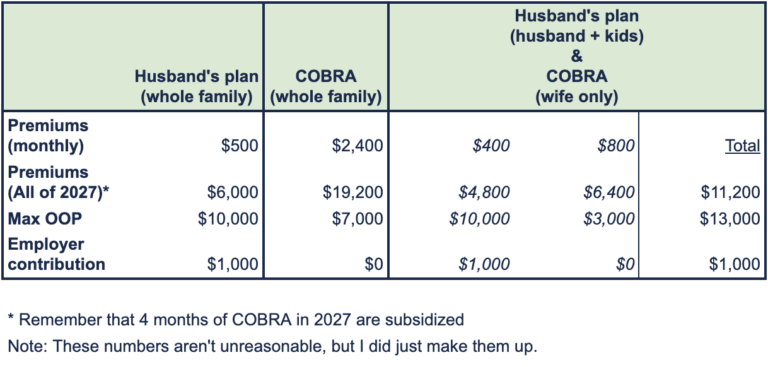
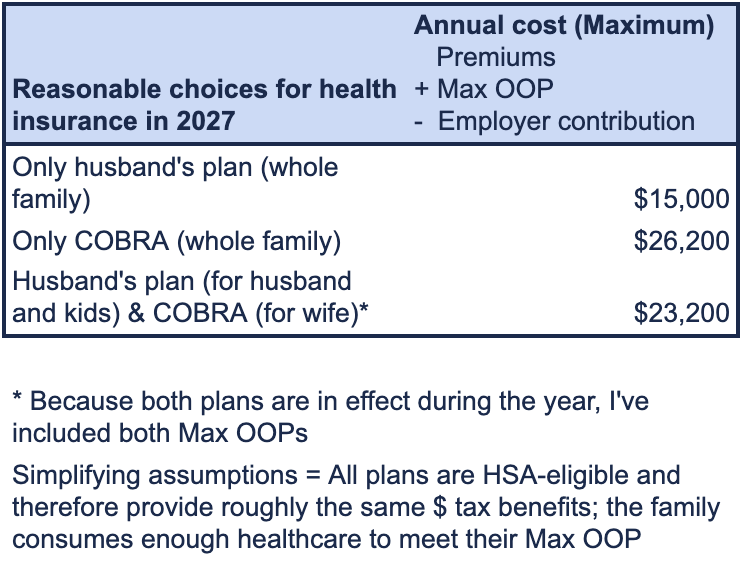
When I prioritize cost, “only husband’s plan” wins.
When I prioritize the ease of continuous care from existing providers during pregnancy and birth and infancy, some amount of COBRA (#2 and #3) wins.
When I balance cost and ease of continuous care from existing providers for the pregnant lady, “Husband’s plan (for husband and kids) & COBRA (for wife)” wins.
So, I will likely recommend to my client that:
- Wife stays on COBRA through 2027.
- Husband and existing children shift to his health insurance plan for 2027 (enroll during open enrollment this fall).
- When their baby is born in 2027, place him or her onto the husband’s health insurance plan.
- At the end of 2027, unless she has by then returned to work with a better health insurance plan, likely enroll the entire family on the husband’s plan. But we will reevaluate this during Fall 2027 open enrollment.
Resources to help you pick the right health insurance plan
I’m not a health insurance expert. (Presumably, most financial planners aren’t.) As you can see, I had to consult some just to write a blog post I could be fairly confident in! So here are some resources and experts for you to explore:
- Move Health
- A local health insurance broker
- The federal government’s COBRA FAQ (which I at least found surprisingly helpful; the bar ain’t high)
A special thanks to a couple of insurance-expert colleagues (Robert Dillard, and Mike Sheeran from Glenn Insurance) for reviewing a draft of this post and helping me understand some of the finer points of the chaos that is our health insurance industry.
Before making any health insurance decision after a layoff, I recommend doing your own research and/or working with a professional.



Disclaimer: This article is provided for educational, general information, and illustration purposes only. Nothing contained in the material constitutes tax advice, a recommendation for purchase or sale of any security, or investment advisory services. We encourage you to consult a financial planner, accountant, and/or legal counsel for advice specific to your situation. Reproduction of this material is prohibited without written permission from Flow Financial Planning, LLC, and all rights are reserved. Read the full Disclaimer.