Your 401(k)’s After-Tax Contributions Are a Retirement Savings and Tax Superpower.

Block Woman surveys muslin money bags with a tag that says "taxes" and a small pile of coins

Hopefully you’ve figured out the basics of your 401(k). Maybe you’ve even figured out whether or not you should contribute to your 401(k) pre-tax or Roth. But what about this after-tax contribution? Otherwise known as the “mega backdoor Roth.”

Around 2018 (when this blog post was originally published, many major revisions ago), after-tax contributions were a precious rarity. By now, most major tech companies offer them. You can see whether your 401(k) plan offers them on the contributions page of your 401(k) portal. Right where it allows you to set contribution percentages for pre-tax and Roth…it might also have an “after-tax” section.

After-tax contributions to your 401(k) can help you supercharge your retirement savings, in an amazingly tax-savvy way.

How After-Tax 401(k) Contributions Work

Step 1. Put Money into Your 401(k).

You can get money into your 401(k) in three ways:

  1. The “normal” contribution from your paycheck
    Put into either your pre-tax account or your Roth account (or both!). In 2025, the “basic limit” (IRS term) for these contributions is $23,500.
    If you’re 50 years old or older, you can contribute another $7500, for a total of $31,000.
  2. Company contributions (usually in the form of a “match”)
    If you’re lucky, your company will also match some of your contributions. Some matches are generous, some are not. Nothing you can do about it.
  3. After-tax contributions
    Even though both these and Roth 401(k) contributions are made with after-tax money (i.e., you don’t get any tax benefit this year by making the contribution), they are not the same thing. They are treated differently.

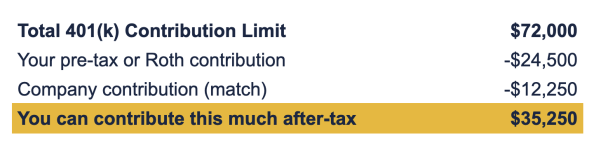
Added together, these three numbers cannot exceed $70,000 in 2025 ($77,500, if you’re 50 or older; with an even higher limit if you’re 60-63 years old).

For example, if your company provides a $6000 match, you can contribute up to $40,500 after-tax:

A-T amount

So, now you could have many “buckets” of money in your 401(k):

  • Pre-tax contributions + earnings
  • Roth contributions + earnings
  • After-tax contributions + earnings
  • Company match contributions + earnings

Step 2. Move Your After-Tax Contributions into a Roth account.

This move-to-Roth is where the real benefits begin.

Most of the big tech companies allow you to do this in an amazingly awesome way that I’m frankly surprised the IRS hasn’t gotten shirty about: You can set it up so that as soon as that after-tax money is contributed, it is instantly/automatically converted to your Roth 401(k) sub-account.

Why is this awesome? Because this means that not only the contributions but also all subsequent earnings on the contributions will be tax-free, because they’re all in the Roth account.

In practice, you should:

  1. Set up after-tax contributions on the 401(k) website. Usually you can do this right where you’re designating the % to go to pre-tax and the % to go to Roth. There will be another section for “after-tax.”
  2. Find the widget/checkbox/what-have-you that allows you to automatically convert after-tax contributions to Roth.
    1. If there is no obvious way to do this on the website, then you need to call your 401(k) provider on the phone and say, “Hey there. I have started making after-tax contributions to my 401(k). I would like those after-tax contributions to be automatically converted to my Roth sub-account. Could you please set that up for me?”

That should be it. All future after-tax contributions should be shoved into the Roth sub-account without further effort on your part. Of course, I’d check after a paycheck or two to make sure.

If your company’s 401(k) doesn’t allow this intra-401(k), automatic conversion, your other options are:

  • Roll your 401(k) into an IRA when you leave the company or when your company terminates or replaces your 401(k) plan. This way you can at least get all future earnings on the after-tax contributions into a Roth account, even if they have been pre-tax up until now.
  • If your 401(k) allows “in-service withdrawals,” you can (probably manually) roll those after-tax contributions into a Roth IRA every paycheck or two.

If You Roll Your 401(k) into an IRA, Pay Attention to How Each of These Buckets of Money Gets Treated

Pre-tax contributions and earnings, and your Company match and earnings, will go into a pre-tax IRA.

Roth contributions and earnings and the after-tax contributions will go into a Roth IRA.

Where the earnings on your after-tax contributions go depends on whether you had the after-tax contributions converted to Roth inside of your 401(k). If you did, then the earnings are Roth money. If not, then the earnings are pre-tax money.

You want to make sure the money ends up in the right kind of IRA. Sometimes “paperwork” gets screwed up and Roth/after-tax money ends up in a pre-tax IRA, or vice-versa, and both are bad. If you catch this mistake, call the company where your IRA lives and they can help you fix it.

The upshot: You can put an extra $40,500 into a Roth account every year. For those of you earning more than $246,000 (married) or $165,000 (single) in 2025, you are not eligible to contribute to a Roth IRA at all. And even if you were eligible, the contribution limit is $7000/year. So, this is an amazing opportunity!

Benefits of After-Tax 401(k) Contributions

Why would you make such contributions?

  1. You can get more much more money into tax-protected accounts than you’d be able to with the usual IRA contributions (witness the $7000 IRA limit vs. $70,000 401(k) limit). The longer you have until retirement, the longer that money has to grow and benefit from its tax-protected status.
  2. You can get more money into a Roth IRA, specifically (eventually, when you roll it over) than your income might otherwise allow you to. If you and your spouse make, say $300,000/year, you simply can’t contribute to a Roth IRA. But you can put after-tax money into a 401(k), and then eventually roll those after-tax contributions (and hopefully earnings) to a Roth IRA.
  3. Your money is much more protected now than it would be if it were invested in a taxable investment account. Money in your 401(k) is protected from creditors, lawsuits, etc.

You Should Probably Make After-Tax 401(k) Contributions If…

  1. You have extra money to save for retirement.
    If you’ve got daycare bills out the wazoo and you’re saving for a down payment, it’s possible you don’t have more retirement savings in you. For now. That’s ok. It’s also possible that you can put some money into the after-tax 401(k), just not max it out.
  2. You’ve maxed out all other (appropriate) tax-protected ways of saving for retirement.
    “Normal” 401(k) contributions are an obvious way to do this. If you’re still eligible for direct IRA contributions (in particular, if you’re eligible to contribute directly to a Roth IRA), do that first. Additionally, Health Savings Accounts can be an incredibly tax-savvy to save for retirement, possibly even better than your 401(k) or IRA!
  3. You already have enough taxable savings and investments.
    All of this money we’re talking about will be in some sort of retirement account. And retirement accounts make it difficult for you to get at your money (for good reason). There are taxes and penalties if you withdraw money. But money you have in bank accounts and in taxable investment accounts, aka brokerage accounts, you can use anytime for anything, no restrictions. This is why I think investing outside your 401(k) is so important.
  4. Your 401(k) is a reasonably good plan.
    You don’t want to trap extra money in your 401(k) every year if it’s a crappy plan, unless you have the opportunity to get the money out of it and into an IRA quickly. Fortunately, I find that plans that offer all these extra whiz bang features like after-tax contributions also seem to be on the ball when it comes to providing a good 401(k).
  5. Your income is so high that just maxing out your “regular” 401(k) isn’t nearly a high-enough savings rate.
    $23,500 is a nice bit of change to save for retirement. But if you’re making $400k/year, that’s only a 6% savings rate. In general, you’re gonna need a much higher savings rate to get to a financially sound retirement. If you put in an additional $40,500 after-tax (from our example above), that brings your savings rate up to 16%. Much better!
  6. You are keen on early-ifying your retirement/financial independence.
    Maybe you have goals that are more important to you than retiring early. Like, say, buying a home, or taking time off with a child, or starting your own business. (And yes, you could justly accuse me of some transference there.) You’re going to be able to support those goals more easily with money invested in a taxable account than with money in a retirement wrapper.
  7. You can either do in-plan conversions of after-tax money to a Roth account, or you expect to be able to roll the money over to an IRA within the next few years.
    If you can’t do in-plan conversions, then the earnings will be pre-tax. The sooner they can get into a Roth account (Roth IRA in this case), and have both the contributions and the earnings grow and remain tax-free, the better.

After-tax 401(k) contributions can be a great way of super-charging your retirement savings in a way that will lower your future tax bill significantly.

Do you make good money? Are you good at saving? Can you almost taste that Financial Independence?

A Case Study in Navigating an IPO

Block Woman surveys white puzzle pieces

Do you want to create a smart strategy for your company’s IPO, but you have options and shares and RSUs, you don’t know how they fit together, and it all just seems irreducibly complex?

Maybe a case study will be helpful, to illustrate how one woman came up with a good solution for her specific life and equity details. My client, let’s call her Mia, has worked for a company, let’s call it FinTech, Inc., for five years. Earlier this year, it went public. Together we created a strategy that she has partly executed so far.

We abided by these priorities when creating the strategy for Mia. This is likely a healthy starting point for you, too.

  1. Define what this money is for in her life (i.e., define her essential goals; what does she need to feel safe, to feel fulfilled).
  2. Sell enough company stock to fully fund those goals.
  3. Minimize taxes while doing this.
  4. Consider keeping company stock only to the extent she doesn’t need the money for an essential goal.

To make sure you are really understanding the meaning of “priorities” here: minimizing taxes is less important than selling company stock to fund her goals. Yes, she might make some tax-inefficient decisions along the way!

Start with the Most Important Thing: What Is This Money for?

Some people already have a list of things and experiences they want to spend money on: buying a house, funding a kid’s college savings account, doing a remodel, taking a sabbatical, etc. Those people should focus on getting enough money out of company stock and into cash or a diversified portfolio ASAP, invested in a way and in an amount that is appropriate for those goals. 

Clearly defined goals make this part of the game pretty easy. In my experience, it’s really easy to convince someone to sell their company stock if they get a house out of it, or a sabbatical, or something that is personally meaningful to them. Convincing them to sell their stock when they don’t have any well-defined need for it…well, it’s less convincing.

This is the situation Mia was in. She has no such clearly defined goals. She has more of a “I want to have strong finances so that I have more choice and flexibility in the future” attitude about money.

In my world, that meant selling a bunch of the company stock (not necessarily all of it, but a bunch) to put it in a robust cash emergency fund and a diversified portfolio that will be less volatile in the future than a single stock would be. Thankfully, Mia was amenable to that. She didn’t hold any strong feelings about the stock.

So, she had an overarching strategy for her work with company stock: Get enough money out of the company stock to build:

  1. A robust cash cushion. (This provides near-term flexibility and protection.)
  2. A retirement portfolio big enough to give her a robust level of financial independence. Not fully financially independent, but financially independent enough. She targeted achieving “Coast FIRE” (having a big enough retirement portfolio that she wouldn’t need to save any more to it), assuming she’d retire16 years from now. (This provides long-term flexibility and protection.)

She could assign a dollar value to each. In Mia’s case, she decided to make it:

  1. 1 year’s worth of expenses, in cash ($100k)
  2.  Looking at her existing retirement portfolio, she needed an additional $700k to be Coast FIRE.

Between the two, Mia will now have way more freedom to make life and career choices that aren’t motivated primarily by “how do I make a lot of money?”

If you’re doing this yourself, write these goals down and put a dollar amount next to them. It’s remarkably helpful, in my experience, to have a visually clear list of the dollar target and the “why.”

Rules of the IPO

FinTech, Inc. had a fairly standard (for the modern era) IPO setup:

  • Double-trigger RSUs fully vested on IPO day.
  • Employees couldn’t sell any shares until six months after IPO day (i.e., there was a six-month lockup). They could exercise options but would have to hold the shares after exercise).
  • If the stock price hit certain desirable targets, there would be a mid-lockup, one-week-long trading window.
  • During that limited trading window, employees could sell 25% of their total ownership as measured on IPO Day. We calculated that Mia “owned” 100,000 shares (between outright shares, vested options, and RSUs vesting on IPO day). She was therefore allowed to sell 25,000 shares.

Strategy in the Years Before the IPO

In each year leading up to the hoped-for-but-we-don’t-really-know IPO, Mia exercised some ISOs. If you have really cheap options, the upper boundary of this exercise should likely be the number of ISOs you could exercise without triggering Alternative Minimum Tax.

In Mia’s case, the exercise price was kinda pricey ($10). So, Mia chose an amount of money that she felt good losing entirely (because that’s what she risked by exercising options in a private company, especially one with no specific plans for a liquidity event), and she exercised as many options as that would buy. Turns out, that was always beneath the AMT threshold. She ended up exercising only a small fraction of her ISOs by the time the IPO rolled around.

(By the way, despite the potential tax awesomeness of exercising ISOs early, it was reasonable for Mia to exercise so few ISOs. Any money you put into exercising private-company options is money you risk losing all of. It is, in fact, entirely rational to delay exercising all options until you can also sell the resulting shares. Although it limits your upside (because your tax rate will be higher), it eliminates your downside.

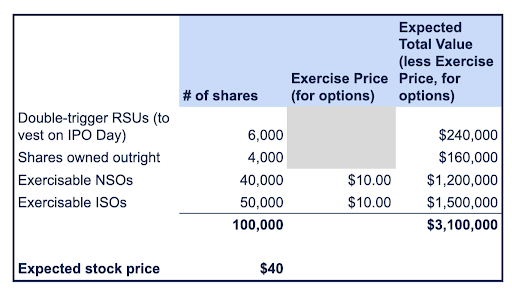
Going into the IPO, she had:

Basically, she had every type of equity comp you could imagine. How should she make the best decisions across the entire suite of equity comp, not just for one type at a time?

Strategy Right Before the IPO: Choose RSU Withholding

Leading up to the IPO, Mia had one big decision to make: When her RSUs vested on IPO day, she could default into the statutory 22% withholding rate for federal income taxes on the RSU value, or she could choose to withhold 37%.

Even though Mia didn’t have much in the way of RSU shares—which meant that this choice didn’t involve a lot of dollars—she chose to have 37% withheld. Why?

  • This reduced her “concentration risk” sooner. We had no idea what was going to happen to the stock price before she’d be able to sell any shares. If the stock listed at $50 and dropped to $20, she would have effectively “sold” at that higher $50. Yay! Even if the stock price ended up increasing, she at least didn’t have to worry about it in the meantime.
  • Even though her RSU income wasn’t going to be big this year (meriting the highest tax-bracket withholding), she had plans for exercising NSOs, and that would make her income high (and therefore tax rate high) this year.

Strategy During the Lockup and Right After: Turn Company Stock into Cash ASAP

After IPO Day, when the rules were in place and we had some sense of the stock price after the company went public, that’s when most of the strategery could usefully happen.

RSUs that Vested on IPO Day

When the special, limited trading window opened up in the middle of lockup, she wanted to diversify (start selling).

Because Mia’s RSUs were “double trigger,” (which is the norm for private-company RSUs), all of Mia’s 6000 time-vested RSUs had fully vested on IPO Day. Almost 50% of the RSUs were withheld (between state income tax and 37% federal tax), so Mia then owned 3000 shares from that vesting.

Leading up to the limited trading window, she didn’t know exactly what she was going to do with those shares. We made this plan:

  • If the company stock rose in price since the IPO, she’d keep it, so she wouldn’t pay the higher short-term capital gains tax on that gain, as she’d only held the shares for a few months. We’d have to sell more of other kinds of shares to fill that 25,000.
  • If the company stock fell in price since the IPO, we’d sell it. She wouldn’t incur any tax bill (although wash sales would likely mean she couldn’t benefit from that tax loss until future years). This would mean we’d sell fewer of the other kinds of shares to fill that 25,000.

As it turns out, the stock price fell from IPO to limited trading window. It had IPOed at $40 and was down to $30, so she sold those 3000 shares she had from IPO Day RSU vesting. These ended up being the tax-wise cheapest shares to sell…because she sold them at a loss. 

She had now sold 3000 of the permitted 25,000 shares.

Shares She Already Owned

Mia owned 4000 shares of company stock. She sold them all during the limited trading window.

Because Mia had already owned these shares for at least one year, she would get the lower, long-term capital gains tax rate when she sold them. These were the second cheapest shares tax-wise to sell.

Had Mia had significant charitable intentions, she might have kept these shares to donate (instead of cash), because that’s tax awesomeness.

One thing that didn’t apply to Mia but might to you: If you acquired the stock early enough in the company’s timeline, it might be Qualified Small Business Stock (QSBS), which would eliminate most or even all federal capital gains tax on the gain when you sell. So, before you sell, make sure you know the stock’s QSBS status!

She had now sold 7000 of the permitted 25,000 shares.

Exercisable NSOs

To sell the remaining 18,000 of the permitted 25,000 shares, she looked to her NSOs. Because you owe income tax (on the “spread” between exercise price and fair market value) the moment you exercise, it costs a lot of money to exercise 18,000 NSOs ($10 x 18,000; plus taxes on the spread). But because she sold at the same time (and she could set aside some of the cash proceeds to pay the taxes), Mia didn’t put any of her existing wealth at risk.

You should know that there is no good reason to exercise and hold NSOs (in a public company). So, when Mia exercised, it was assumed that she would also sell. Read my favorite blog post on this topic.

We also took into consideration the idea of the “leverage” her options provided (leverage = exercise price / fair market value). NSO leverage isn’t a particularly intuitive concept (at least, not to me!) but it boils down to this: It would be silly to exercise the options at $10 if the fair market value were only $11. You only get, in a sense, $1 of value. That leverage is high ($10/$11 = 91%). It’s better to wait until you get more bang for your exercise buck.

During the trading window, however, the stock price was $30, so leverage was 33% ($10/$30). Leverage below 40% makes it worthwhile, as a rule of thumb.

RSUs as They Vest, Now in a Public Company

One of the challenging transitions when your company goes from private to public is how your RSUs work. When your company is private, usually you have no control over RSUs and do nothing. It is just Future Fantasy Money. Once your company is public, when those RSUs reach their vesting date…

  • They immediately turn into stock.
  • They are treated as taxable income.
  • You can sell them for actual dollars.
  • You probably don’t have enough taxes withheld on the vest and will therefore end up with surprise tax bills.

The best practice for RSUs, in public companies, after they vest is: Sell ASAP. And this is what Mia is doing. Remember, there is no tax benefit to holding RSU shares after they vest. No really.

Remember, as long as Mia remains an employee, she will continue to get new stock via RSUs vesting. So, whatever the fate of the company stock, she will share in it via the value of those RSUs upon vest, even if she were to sell all the rest of her stock.

Exercisable ISOs

I consider ISOs the most complicated of equity comp types, so I leave it for last, both in this blog post, and in Mia’s strategy in general.

ISOs have this awesome tax treatment of not incurring tax at exercise as long as you stay under the Alternative Minimum Tax threshold. (Remember that this is in contrast to exercising NSOs; tax is always due when you exercise NSOs.) Also, as long as you hold the stock for at least a year after exercise, you’ll get the lower long-term capital gains tax rate on the gain when you eventually sell.

Add on top: That AMT threshold, in general, goes up the higher your ordinary income is. So, with the RSUs that vested at IPO and continue to vest every quarter now that the company is public, and especially with the exercise of NSOs, she now has a very high ordinary income this year.

What does that mean for Mia’s ISO strategy? It allows her to exercise (and hold…to get the tax benefits) a bunch of ISOs with no tax bill.

How many? Welp, this is where she brought in her CPA and asked them to model how many ISOs Mia can exercise without triggering AMT. Thank you, CPAs with equity-comp expertise and a service model that includes an annual tax projection!

I still advised Mia to only exercise as many ISOs this year as she could without triggering AMT. Why? 

  • She doesn’t plan to leave the company in the near future, so she should have future years in which to continue to exercise the ISOs. (After you leave a company, your ISOs might outright expire. But if they don’t, they will convert, by law, to NSOs after 90 days.)
  • This keeps her risk of losing money with the company stock lower. Sure, she’s putting that exercise-price money at risk, but she’s not also putting tax money at risk.

Yes, this will add to her collection of company stock (in conflict with our general goal of reducing the concentration). She is knowingly increasing concentration risk because the possible tax benefits are so good. By itself, that likely wouldn’t be enough, but this is only one part of a larger strategy of sell, sell, sell.

I find this bit of mental accounting helpful: Mia isn’t putting any of her existing wealth at risk. The money she’s risking by exercising and holding ISOs is money she got from selling other FinTech, Inc. stock.

[Side note: AMT is not to be avoided at all costs under all circumstances. There are situations in which exercising a bunch of ISOs and triggering AMT is a reasonable choice. If you pay AMT this year, you get an AMT credit and it’s possible to get that credit back in future years. That said, it still puts you at higher risk of loss. You’re spending more money to buy stock…whose price might then drop.]

Strategy in 2026 and Beyond: She Can Be a Bit More Nuanced

Remember our high-level strategy:

Priority #1 = Sell enough stock to fund goals.
Priority #2 = Minimize taxes.

What does this prioritization look like in practice? In Year 1, sell sell sell. In Years 2+, once she has funded her goals from those Year 1 sales, she can choose to slow down the sales and let tax considerations (or risk-taking) drive the bus more often.

What will she do with her RSUs? Mia will continue to sell them as they vest in 2026 and beyond, as long as she stays at FinTech, Inc. Because, to repeat the message, there is no tax advantage in holding on to RSUs after they vest.

What will she do with the shares from exercised ISOs? These are only shares she will hold. She’s going to hang on to them for a full year (to get the lower tax rate on the gains) and then sell. If Mia develops a charitable plan in the meantime, these ISO shares (assuming the fair market value is higher than their $10 cost basis) will likely be the things she should donate to charity, not cash.

What will she do with her exercisable options? Each year she starts the NSO/ISO dance again:

  1. She exercises (and sells) some NSOs (as long as leverage < 40%).
  2. If she wants to prioritize taxes over diversification, she could reduce the number of NSOs she exercises in order to keep her income below a certain tax rate. (Her CPA can help her calculate just how many NSOs that is.)
  3. Then she sees how many ISOs she can exercise (and hold) without triggering AMT.

She now has much more flexibility in how she treats company stock:

  • Keep more: If she has an emotional connection to the stock, or doesn’t want to sell everything because “what if?!”, then cool, let’s leave more NSOs unexercised or let’s keep some exercised ISO shares past the one-year date.
  • Keep less/none: Statistically speaking, any concentration in a single stock increases your risk without a concomitant increase in your reward. 100% diversification (i.e., getting out of all of her stock) is her best chance of having successful long-term investing. This, by the way, is where I stand. But I don’t impose this perspective on clients when their life goals don’t require it.

There’s more detail to the “2026 and beyond” strategy, but I’m keeping things short and simple here for the sake of digestibility.

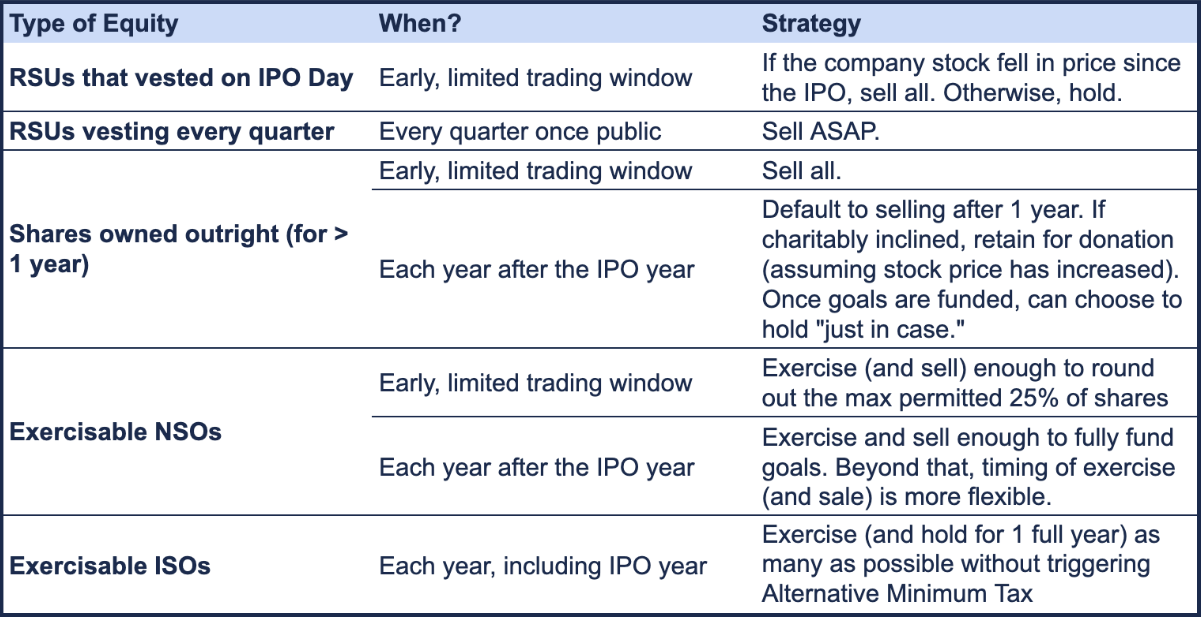
Here’s a summary of Mia’s strategy by type of equity:

Feeling overwhelmed? I’m not surprised.

Have a better sense that all these pieces can and should fit together? I hope so.

Convinced of the primary importance of clarifying what this money is for in your life, and of orienting all your decisions around supporting that? Good.

If you want to work with a financial planner who can help guide you through your IPO in a way that feels right and true, reach out. Even if I can’t help you myself, I Know People.

Why a Traditional Investment Portfolio is Better than Real Estate

Pink Block Woman is standing on part of a Monolopy game board with a red hotel game piece and two green house game pieces. A blue Boardwalk card is partially visible.

If you want to invest in real estate because you want passive income, keep this in mind: There is no kind of investing that produces income more passively than a traditional investment portfolio.

When I talk about a “traditional investment portfolio,” I mean owning individual stocks and bonds or, more likely, funds (mutual funds, index funds, ETFs) of stocks and bonds in accounts like a 401(k), IRA, and taxable brokerage account. You know, the Boring Stuff.

If you’re looking for passive income, a traditional investment portfolio can create that easily! You just sell shares of the aforementioned stocks, bonds, or funds with a few clicks of a button and take the cash.

(Okay, yes, investing is more nuanced than that. But apparently it has never occurred to most people that you can generate income from a traditional portfolio just by selling stuff. In fact, that’s probably how most clients of most financial advisors get income when they retire!)

The Potential Benefits of Owning Investment Property

I’m not a “real estate guy.” I know financial planners who are, and who specialize in helping people build wealth through real estate investing, like this planner. If you’re interested in buying real estate, you likely don’t need me to enumerate its virtues, but let me give it a bit of screen space…before I start digging into the potential negatives.

It Scratches that Cultural Itch We Almost All Have.

It’s pretty clear that, in this country, we love owning property we can touch. Also there’s a deep-seated appeal to the idea that “If I buy a property, then not only do I now own an asset that increases in value over time, I also get checks every month. It’s the best of both worlds.”

And that’s okay.

It Might Help You Reduce Taxes Over Your Lifetime.

I’m not an expert on this. TikTok will give you all sorts of wrong and potentially “If the IRS finds out, you’re going to jail” advice on using real estate to reduce or avoid taxes.

In the legitimate world, I know and respect enough tax and financial planning professionals with real estate expertise to know that there are legitimate ways that real estate can help optimize your taxes over your lifetime.

Please keep in mind that, we generally shouldn’t care about optimizing taxes in any one year (which unfortunately is the focus of far too much tax advice). Who cares if you save $5k in taxes this year…if you still have to pay that money plus more in the future? The goal is to minimize taxes across your entire lifetime. And sometimes that means that paying less in taxes this year is the wrong thing to do.

It Can Be Emotionally Easier to be a Successful Long-Term Investor.

Behavior is a huge component of investment success. If you want to be a successful investor in the long term, you want to be a long-term investor (duh). The most reliable way to accomplish this is to buy investments and then just keep holding them.

In this way, owning real estate directly can have an advantage over a traditional investment portfolio.

You can see the value of your stock, bond, or ETF every day. When it goes up, glorious! You’re floating on air! Envisioning those first-class tickets you can now afford. When it goes down, ack! Gloom and doom and everything is horrible.

When you own, say, a single-family rental home, you know what its true value is on the day you buy it (i.e., it’s the price you paid) and the day you sell it (i.e., it’s the price someone else is willing to pay for it). The best you can do on every other day is “comps,” which are just informed guesses, and not a number you’re confronting daily in the headlines.

We financial planners try to train clients to not look at their investment portfolio very often, so as to minimize the self-defeating emotions that looking at the numbers can stir up. You don’t have to worry nearly as much about that if you own a single-family home…because there’s nothing for you to see. It’s  therefore easy to ignore the daily, weekly, annual vacillations in the value of a single-family home. That probably makes it easier, emotionally, to own long term.

The Downsides of Owning Real Estate, and How to Avoid Them by Owning a Traditional Investment Portfolio

It’s Often Anything but Passive.

As the saying goes, “Your index fund doesn’t call you at 3 a.m. to complain about a leaky pipe.”

For sure, you can reduce this problem by hiring a property management company. But that is still one more relationship you have to commit time and energy to, and it doesn’t get you out of all decisions and effort associated with the investment property. (Not to mention the cost, of course.)

Even after you buy it, you have to keep spending on it.

You have to pay the pest guy every month to come keep the rats out. Or the landscaper to keep the lawn mowed. Or the property tax. Insurance. Or repairing the roof. Replacing the carpet. Paying a property management company. Etc. If you own your own home, you already are well aware of many of these “hidden” costs of owning real estate.

Yes, obviously the point is for rent to cover these costs. And ideally it will (plus some!). But just keep in mind that these costs are always there…rent may or may not be.

It increases the complexity of your financial life.

It is hard enough keeping track of all your 401(k)s and IRAs and 529s and Robinhood and Coinbase accounts, not to mention your eight different bank accounts.

Now you’re going to add an entirely different kind of asset to the mix, with an entirely different way of tracking and managing it. Not a deal breaker! But it should be a consideration.

Unfortunately, I think our modern financial lives are irreducibly complex. We cannot make them simple. But we can fight to make them simpler. Not only does that make our lives more pleasant, but I firmly believe it indirectly benefits us financially. We’re more likely to understand and stay on top of all the bits and pieces when there are fewer moving parts.

You’ve just complicated your taxes (and have to pay for that complication).

This is a special case of the above mention of complexity. But I think it warrants calling it out by itself, because taxes are such a source of stress and anxiety for most of us.

Somebody has to prepare Schedule E—and possibly a bevy of other schedules and forms, depending on what you’re doing with your real estate—on your tax return. Either you’re taking your time and energy to do it (which I highly recommend against), or you’re now paying your CPA more money to plan more and do more tax paperwork.

Real estate prices don't actually grow all that much over time.

The stock market, historically, has meaningfully outperformed real estate. According to this Investopedia article,

The S&P 500 index, which tracks the performance of the 500 largest U.S. public companies, has delivered an average annual return of 10.39% (including dividends) from 1992 to 2024, resulting in an inflation-adjusted return of 7.66%. During the same period, the U.S. housing market grew at about 5.5% annually.

Yes, there are regional variations.

Real estate—much like company stock or a cryptocurrency—tends to produce a lot of stories (from your cousin or your co-worker or the internet). But stories aren’t a good basis for long-term investing. Data is.

You just increased your investment risk.

You’re probably aware of the benefits of “diversification.” Diversification means, simplistically, owning lots of stocks instead of only a handful of stocks. It’s described as “the only free lunch in investing.”

If you looked at someone’s net worth (possibly even your own!), saw that it was $2M and that $1M of it was in their company stock, I bet you’d be all “Whoa….that’s a bit crazy.”

But if you buy real estate as an investment, you’re likely going to be putting a lot of money into that investment and could end up in the very same situation, where $1M of your net worth is in this single investment property.

Concentration risk is concentration risk. That one house gets hit by an earthquake. That one neighborhood becomes unpopular. These things are outside of your control but have a huge effect on that one asset. It’s similar to owning a bunch of a single company’s stock, say, BlueApron, and then riding the stock down from its IPO price of $10 to below $1 less than two years later.

It’s illiquid. Otherwise known as, you can’t buy groceries tomorrow with your property value today.

I’ve written a critique of investing in “fancy” investments. One of those critiques is that many fancy investments are “illiquid,” that is, you can’t easily sell it and turn it into dollars to buy groceries with tomorrow.

The same thing applies to owning real estate. You do have some tools for getting money out of these assets if you need it, like a cash-out refinance. But in general it is way easier, faster, and less expensive to get money out of a traditional investment portfolio. You just sell shares of your stocks and bonds and funds during the next day that the stock market is open. Which it is almost every weekday of the year.

You can’t just buy or sell small bits at a time. It’s all or nothing. That might not match up with your finances.

When you’re buying a property, you likely need a lot of money as a downpayment. (Sure, at times you can secure a mortgage that enables you to make a very small downpayment. I’d argue that just because you can doesn’t mean you should.)

Maybe you only have $100s or a few $1000s at a time to invest. You can either wait, maybe years, to accumulate enough to buy real estate…or you can just start buying stock and bond funds Right Now. You can usually start investing in a traditional portfolio with just a few bucks.

Now let’s say you need some money, say, $50,000 out of your investment portfolio. You can easily sell $50,000 out of your $2M investments…if it’s a traditional investment portfolio. But how do you get $50,000 out of your $2M investment property (or four $500k investment properties)? It’s probably possible, but it sure as heck is also more complicated.

This might be the wrong time, in your financial life, to receive more income.

When you’re retired and living off of your investments, having an investment that generates income every (or most) months could be a great match for your needs.

When you’re still working and earning a paycheck, you might not want additional monthly income from your investments, and it certainly isn’t appealing from a tax perspective. Why pay taxes on income that you don’t need if you could instead delay that income into the future when you do need it?

Either way, you might not have as much control over when you receive—and are taxed on—the income.

By contrast, you have a lot of control over income and taxation timing when you own a traditional investment portfolio. Yes, even the most tax-efficient stock, bond, or fund distributes dividends, interest, and capital gains on occasion, at a time that you have no control over. But you can minimize current income (by quite a lot!) by choosing tax-efficient investments and strategically choosing when you sell the investment.

I know there are a lot of tax maneuvers to reduce your current taxable income from investment real estate. Maybe you can arrange it so that the tax impact of the real estate income is a non-issue. You’d want to work with a tax professional to figure that out before committing.

Most people don’t have the skills and experience to properly evaluate a real estate investment opportunity.

I know I don’t, which is a big reason I don’t invest in real estate or seek to provide much advice to clients.

The wonderful thing about a traditional investment portfolio is that it’s easy to understand and implement the best practices of “own a diversified portfolio of low-cost funds, mostly in stocks when you’re many years away from your investment goal.” I don’t have to know—and I don’t—how to evaluate the investment worthiness of Airbnb or Coca Cola or Exxon to successfully invest in the stock market.

If you’re going to drop $100ks into a single investment property, you’d better know how to evaluate its investment worthiness. If you do, yay! But I reckon that more people think they do than actually do, and it’s too big a risk to take without actually being one of those few.

When Owning Real Estate Could Be a Good Solution for You

You like the game.

You like evaluating properties and bidding on them and managing properties and improving properties and maybe even the interpersonal demands of tenant relationships.

One of the things I love about my traditional investment portfolio is that I basically never have to think about it (even before I hired my own financial planner). I just set it up once, plow money regularly into it from my paychecks, and check in once a year to make sure it’s all copacetic. I really really don’t want to have to think about my investments more frequently.

You have the necessary expertise to evaluate the investment.

You have sufficient expertise or have hired professional expertise so you can properly evaluate investment opportunities.

You have the necessary skills to maintain properties.

You either have the skills to maintain properties or have a network of professionals who are willing to do it for you.

If You Really Want to Own Real Estate

There are smart, successful people out there who grew meaningful wealth through real estate. I’m not one of them, and I don’t know enough about real estate to help anyone else be one of them.

If you want to own real estate but don’t like the idea of everything that comes with tangible property, considering owning real estate through a public REIT (real estate investment trust), which offers the same ease and liquidity of your S&P 500 fund.

And don’t forget that if you own a “total US stock market” fund, you almost certainly are already invested in real estate. Vanguard’s Total US Stock Market ETF (ticker: VTI), for example, currently allocates about 2.5% of its money to real estate.

If you really want to own something you can touch, then alright.

Because of the complexity and cost involved in evaluating, buying, maintaining, and managing property, I recommend you work with a specialized financial planner (not a real estate professional, who would probably have pretty profound conflicts of interests or unhelpful biases). You can start that search in the XY Planning Network’s Find an Advisor tool, filtering by Profession > Real Estate Professionals.

Do you want to build wealth and passive income the easier way?